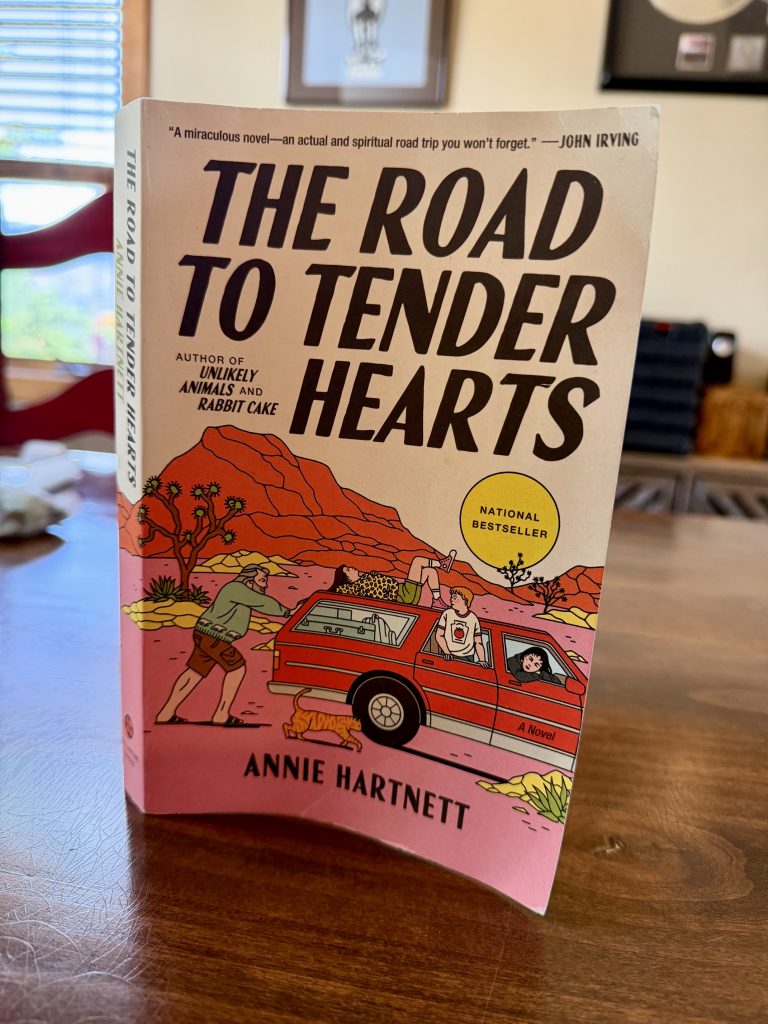
 Annie Hartnett has done it again. She skillfully wrote a book that tackles unimaginable tragedies while inserting humor, relatable situations, and relevant characters. Published in 2025, The Road To Tender Hearts is about what the family you choose (or chooses you) looks like, raising and understanding children, the importance of animals, what going on new adventures and seeing new landscapes teaches us, and why listening is everything.
PJ Halliday and his daughter Sophie embark on a cross-country road trip with two orphan kids who kind of fall into their laps (I know, stay with me) and everyone learns so much about themselves and one another. While all the aforementioned themes are highlighted throughout the narrative, the theme of listening is huge. Told from several different points of view, all in third person, the author shows why listening matters to everyone and why not feeling heard is especially tough on kids. “She was happy because someone listened to her. Adults never listen to us.” The miscommunication and hurt feelings that result from not listening is prevalent and reminds the reader why hearing someone out is so important. A major example is people thinking they know what’s best for others when they actually don’t, and how easily the correct information could have been received if listening took place.
As per usual with a Hartnett novel, all the characters are nuanced and fascinating. Details are everything. PJ is the ultimate protagonist/antagonist because he is one of those people you can’t live with but also can’t live without. Irresponsible but loving, spontaneous and exhausting, charismatic and annoying, he is also an alcoholic who has endured unimaginable loss and lived to see the other side. “He needed someone to tell the truth to, and it was easier to tell the truth at a bar.” PJ is, somehow, both a giver and a taker which make him simultaneously someone you want to root for and someone you want to punch in the face.
One of my favorite aspects of the book is the idea that doing the best for your family – and by that I mean the members that mean something to you rather than the ones you have out of obligation – is what matters the most. “Sometimes limiting contact is healthy. Family obligation is not as important as mental health.” YES! Luna and Ollie’s horrible parents exemplify this extremely vital lesson as they fail their kids deeply and repeatedly. It hurts to read. Spending time with anyone who is abusive or selfish is an awful way to live. Thankfully, Luna and Ollie find themselves in the care of two family members (PJ and Sophie) who are loving and attentive. As the tale unfolds, they realize how this new family dynamic might save them all.
Throughout the narrative, Hartnett demonstrates the importance of saving love and energy for those who care about you as much as you care about them. “There was never much arguing with her father; he would continue to do whatever he wanted, forever.” The idea that neither adults nor kids have to forgive people if they don’t want to definitely hits home. My mother, who is one of my favorite humans, is constantly doing things out of obligation. For someone who cares so much about family, her definition of who qualifies as part of hers is skewed and Hartnett shines a necessary, glaring light on that thought process.
An aspect of the author’s writing that impressed me with this novel and Unlikely Animals is her knack for giving voices to people, creatures, and objects that can’t speak for themselves. She also knows how to tell stories within stories by providing just enough details that show how characters are intertwined without going overboard. “Thanks for not telling us a story for babies. Thanks for telling us a real story.” Writers tend to write what they know and I’ve noticed that animals play dynamic roles in her books, as do father/daughter relationships, addiction, and events (both positive and negative) that take place in small towns.
In chapter 17, PJ talks about kids being adaptable. In chapter 43, Sophie tells her dad that kids are good at forgiving. Later in the book, that thought process shifts a bit in a revelation that brought tears to my eyes: “Kids aren’t resilient. That’s something adults like to say to make themselves feel better. To pretend kids don’t feel as deeply as adults do. But kids are everything that happens to them. They’re sponges. Everything bad, everything good. Every hurtful thing you say. Every loving one.” Parenting is simultaneously fun, incredibly hard, and the greatest adventure on the planet. I do my best to stay aware that everything we do and say impacts our son – for better or worse.
One of my favorite quotes and a big takeaway from this book: “A person needs three things to be happy: something to do, someone to love, and something to look forward to.” Absolutely words to live by because adventures lead to life lessons and positive childhood memories.
Throughout the story, the characters exemplify how, even as adults, we wonder what our parents think and if they are proud. I think that serves as a reminder to never give up on the people we love with the caveat of not sticking around because one feels obligated. “She didn’t know what she needed her dad for, exactly, he was no help to her or to anyone else, but she needed him. To be a burden, maybe. To be a total and constant pain in the ass.”
Before reading the exceptionally heartfelt Acknowledgements section, I knew Hartnett was a mother because she consistently points out that kids are always watching and little comments they hear run deep. She also bravely mentions that she put all of her fears and anxieties into this book and says, “It feels good when we can laugh together about hard things.” Amen. It’s clear that her heart and soul are in her writing (I get it – people reading my words means everything to me too), that she has a true partner in her husband Drew, and their daughter Leora is the light of her life. Lucky for me, I can relate.
Quotes
“PJ thought he saw something he understood in her eyes. A hurt and an anger he recognized. He was worried for her, being so young and having that kind of hurt.”
“Everything up ahead might be wonderful.”
“Sophie regretted telling the girl she was sorry for her loss. It was an empty thing to say.”
“Sometimes people survive the impossible without even trying to pull a stunt.”
“She remembered her mom telling her it was hard to hear criticism about things that mattered to you.”
“These kids liked stories, real stories, good ones.”
“Sophie wondered if places always find a way to live up to their name, the way people do.”
“You tell the story in order to control the story.”
“Loving kids is reaching them new things, and being delighted when they learn it.”
“We’ll give them consistency and a routine. We’ll listen to them. We’ll love them. We’ll love them exactly as they are, even when they fuck up.”
“Sometimes it’s too hard to see what’s right in front of you.”
“You’ll always worry because part of loving children is worrying about them. Worrying about them and hoping for them.”
Acknowledgements
“The very best thing about having an only child is there is only one person I love the most, the single person I love more than anyone else on the planet. You are the joyful corner of my heart, the part of my body where all the sweetness lives.” Me too Fleet. ❤️
Fun Facts
A baby alpaca is called a cria and when an alpaca gives birth, it’s called an unpacking.
I started reading this book on the way to Massachusetts (where the story takes place) and finished it on the way back to Colorado.


beautiful observations! i love that this book made you feel things and that you appreciate the life lessons from the flawed characters as much as i do.
Life lessons from flawed characters! Yes! Thank you for always giving my the best reading recommendations.