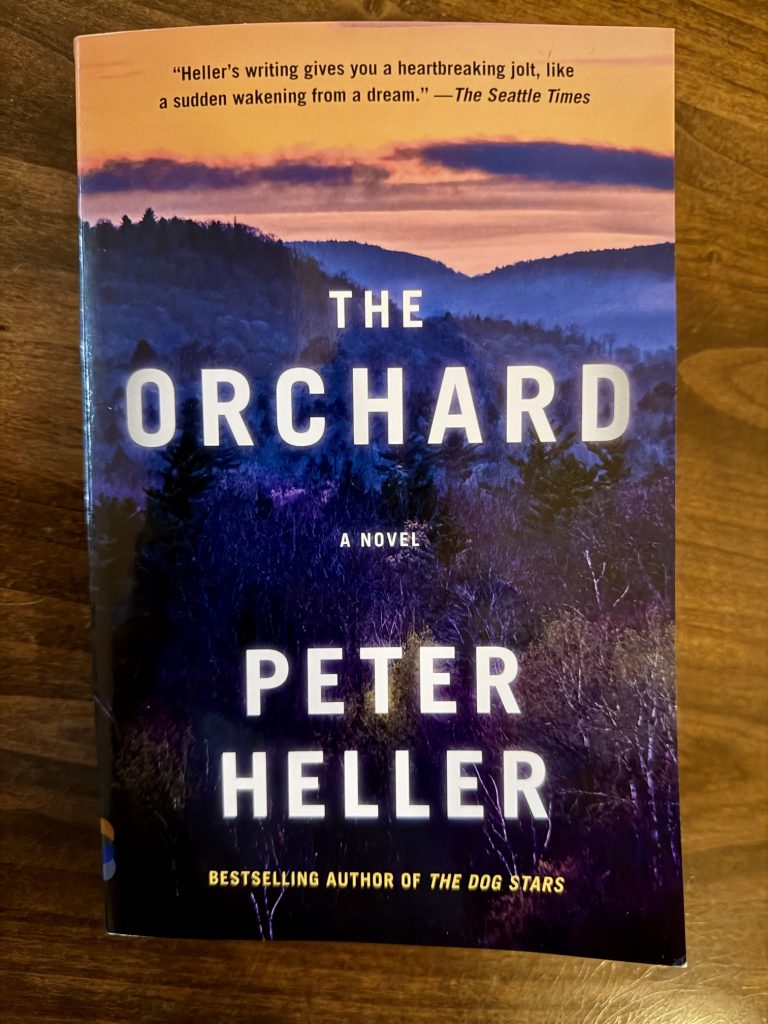
 As I’m sitting down to write this review, I’m realizing that I just finished my sixth Peter Heller book! The Painter, Celine, Kook, The River, The Last Ranger, and now The Orchard. The only other author with those kinds of numbers is Taylor Jenkins Reid as I read Daisy Jones, Malibu Rising, Evelyn Hugo, Carrie Soto, and Atmosphere.
I’ve seen Heller speak twice and he’s good – but from what I remember from his presentation, his description of this book didn’t really do the content justice. When he visited The Bookworm in December 2025 in support of The Orchard, he spent a lot of time talking about one of the main characters translating Tang dynasty poetry. No offense to the Tang dynasty, but that aspect didn’t really grab my attention – which is probably why the book sat on my office shelf for six months before I made time to read it.
In Heller’s defense, the translator piece can be seen as a hook for the story but that’s not what the story is about. Instead, the focus is the relationship between mom (Hayley), seven-year-old daughter (Frith – named for a snow queen), and dog (Bear) who live off the grid without electricity and work hard to make a living off the apple orchard on which their cabin resides. Frith only goes to school once a week and lives a feral, “noncompliant” upbringing that is full of love and out of the ordinary idiosyncrasies. For example, their neighbors include an older woman with dementia, a motorcycle gang, beavers (one so big they call it Beaversaurus!), and hawks. It’s odd but they are a family and love one another very much. Then, out of nowhere, a woman named Rosie comes into their lives and inserts herself into the family which adds another layer of familial opportunity. “We were a team, indivisible, the nurturing going in all directions. A team of three.”
Going back and forth between present day and Frith’s childhood memories, Heller seamlessly writes from the point of view of a grown 34-year-old woman and a young girl which is very impressive. What’s also interesting is that the author has Frith call her mother Hayley rather than Mom. “In moments of vulnerability, I thought of her as Mom. But those moments always scared me, and so I liked her much better as Hayley.” Foreshadowing. In chapter one, Frith points out that “childhood memories are subject to constant revision” and that it’s “funny what you recall.” I often think about what Fleet, who is currently seven years old, will recall as his memory is incredibly accurate. It will be interesting to see what he remembers as he gets older – small things like seeing a red-tailed hawk swoop on a walk or big things like family trips. Most likely both. I love how excited Frith gets hearing the adults around her tell stories – it makes me smile because Fleet loves that too. Our story is his story.
I consider Heller a hometown writer because if he’s not writing about Colorado and/or fly-fishing, he finds a way to insert both into his narratives. Although The Orchard takes places in Vermont, our main characters moved from Denver and know how to fly-fish. Because of where and how they live, Frith retrospectively remembers how much of their daily lives was about survival – a lot to understand and go through for a young kid. As the book goes on, I see why Hayley wanted to hide but living the way they did in the beginning seems like an unnecessary overcorrection. “She had an ingrained sense of fun that expressed itself when the pressures of survival lifted just a little.” In chapter seven, Frith wonders if the move from Denver to Putney was self-exile or salvation. Great question. When seven-year-old Frith talks about how she views Hayley when people look at her like the famous person that she is, there is so much pride. As an adult reading the translated poems, Frith realizes that “the two women, across twelve centuries, were going through similar loss and sharing the language.” Apparently, one does not have to know the source language to be a brilliant translator. Such an oddly specific job for Heller to write about but it works.
A favorite part of the book is when Hayley gets invited to a conference in Jackson Hole. There is something about a writer you like describing a place you’ve been. In this case, it’s through the eyes of a young girl which is even more fun! “I felt just then, on the bench, part of a privileged circle of non-crazy people, which was nice.” So simple yet it says so much as this marks the first trip Frith goes on with Hayley and Rosie for fun – her first vacation. Anyone with young kids knows that traveling is seeing things through their eyes which is the best.
Without ruining the book, I want to say that the last few chapters broke my heart in ways I was not at all prepared for because life is so unfair for so many people. That being said, as I was reading, I took solace in how the people we surround ourselves with shape who we are and, if you’re lucky, they can save your soul. “She was a force, for sure…I felt proud. That’s my mom. I wanted to tell them all.” That, right there, is everything.
Quotes
“The apples are noncompliant,” I said. Rosie laughed. “The best things often are,” she said.
“I don’t think people pay enough attention to the momentous times in our lives when nothing happens.” A reminder to sit back and enjoy it all.
“She taught me that I could fiercely love something I didn’t understand in the least.”
“Funny to see someone we think we know top to bottom change in another’s company.”
“Hayley was nothing if not game.”
“Silence can sometimes be louder than thunder.”
“A thunderous herald of conflict and apocalypse.”
“the most powerful attribute of evil is that it invites us to battle it”
“I thought how grown-ups must spend half their time trying to figure out the difference between the right thing and the wrong thing. It seemed pretty tough.”
“I believe that animals have way more intelligence than we ever give them credit for, often surpassing our own.” AMEN.
“the cool reserve she carried with her the way a mountain makes its own weather” What a line!
“She knew in her heart, I guess, that one day I would make plenty of weather on my own.”
“Well, we are all suckers for a great story.” YES!


Leave a Reply