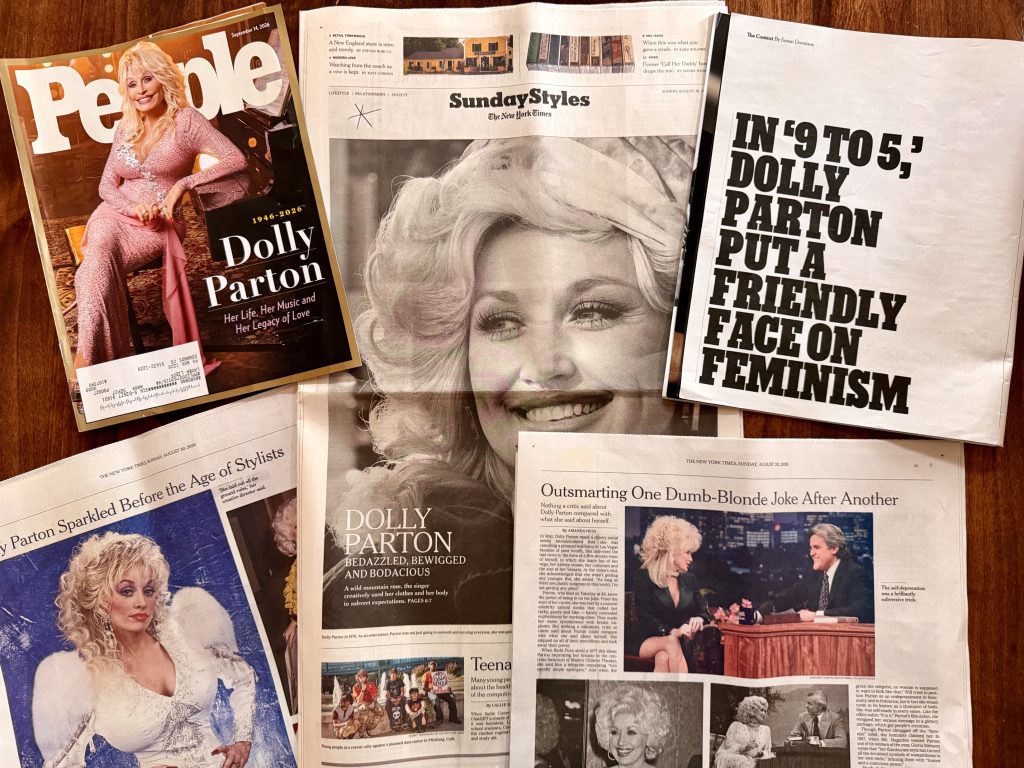
 Since Dolly Parton’s death on August 25, I’ve read a myriad of articles in multiple publications about her life, philanthropy, legacy, and music. Everyone seems to have a Parton story and they all want to tell it. In a time when no one seems to agree on anything, and everyone is looking for a reason to argue, reading about someone positive has been a breath of fresh air.
New York Times contributor Tressie McMillan focused on Parton’s ability as a writer. McMillan said that among all of Parton’s accomplishments, her writing was her greatest contribution: “Loving Dolly Rebecca Parton was easy. She was beautiful, funny, and kind. She was a country music original, a glittering pop star, a scene-stealing actor, a cultural icon, and an unparalleled humanitarian. But Dolly didn’t see herself as a saint; she identified as something we needed more: a writer.” McMillan went on to point out the importance of and meaning behind writing for all types of people. “The way she lived and worked, the way she sparkled and demurred, the way she took up space and took the hits for being larger than life is proof that a good story can change the way we see the world. Dolly Parton was a writer. In the end, Dolly Parton is the greatest story that Dolly ever wrote.”
When New York Times Magazine published its “30 Greatest Living American Songwriters” list in April 2016, Parton was still alive and, of course, her name was on it. The magazine called her a “unicorn of a human” whose “songs speak to the ‘everyperson’ in all of us [while] her voice backs up the integrity of the lyrics.” While I’m sure that list stirred up some controversy (these types of lists always do), I guarantee no one argued about Parton’s place on it.
One of my favorite music writers of all time, Rob Sheffield, focused on her contribution to music in his Rolling Stone article titled “Why We Will Always Love Dolly Parton.” He called her “a visionary with an endless imagination for how far American music could reach.” He added, “We’re grieving for Dolly now because she represents the best in us.” Amen. He talked about how she never apologized for being exactly who she was – because all the glitz and glam was part of her personality rather than a way to cover up a lack of talent. People didn’t know what to do with her which made her even cooler. “The mainstream media and the world of late-night talk shows often had trouble getting past the image, seeing her as a lovable show-biz entertainer rather than a fiercely driven songwriter, or as she put it, ‘songteller.’” Sheffield then namechecked the wide variety of musicians who covered her songs: Jack White, Tina Turner, Jerry Garcia, Merle Haggard, Stevie Nicks, and, of course, Whitney Houston. He also pointed out her down-to-earth, down-home personality being current in every decade and therefore always in style. “It says everything about Dolly Parton that she made her final public appearance near Nashville, but not onstage or on TV – at a truck stop on I-65, in June.”
In a New York Times Magazine article published after Parton’s death, writer Susan Dominus highlighted the artist’s contribution to feminism starting with her role in the movie 9 to 5 and the hit song she wrote bearing the same name. Although Parton stayed out of politics, she made statements just by being herself. “Parton knew [Jane] Fonda was being strategic by casting her in [the movie], in hopes of bringing in a Southern audience.” Dominus also pointed out that, at the time, Parton was an “unexpected feminist symbol” who took a chance professionally aligning herself in the movie with Fonda who was very political and controversial. “She also helped reframe feminism’s image to emphasize more universally relatable demands for an egalitarian, humane workplace” which is why “9 to 5” is “a song every American can hum along to.”
While each article presented its own angle, many of them touched on a few major points that made Dolly Parton’s story so unique:
- She grew up in poverty in Tennessee with a ton of siblings and loving parents but her father could not read.
- Her over-the-top glamour was the greatest trick she ever played on the public.
- The persona she created for herself set her apart – decades before social media or influencers existed.
- Some people didn’t know what to think or make of her which was part of her charm. She was truly compassionate, one-of-a-kind, and brilliant which is why the rhinestones, wigs, long nails, high heels, big boobs, and sparkles only elevated their admiration for her.
- Journalists, talk show hosts, and even Barbara Walters (sometimes women are the worst) tried to rattle her during interviews – I guess because they couldn’t wrap their heads around how she was able to look the way she looked while still being so talented.
- Parton was beyond philanthropic and prioritized literacy, children, and those experiencing the poverty she dealt with as a child.
While all facets of Parton’s history are fascinating, my main takeaway from all the articles I read is that she seriously did not care what anyone thought. Most people say they don’t care about what others think when they really do. It’s human nature to want validation of some sort but clearly part of the reason Parton survived show business so long is that she honestly did not give a fuck about what others thought of her. If the press gave her a hard time or asked questions designed to embarrass, others might have (understandably) retreated or lashed back. Instead, Parton calmly took the higher, funny road. She turned eye-rolling comments about her appearance into clever quips – not in a self-deprecating way but in a smart, thoughtful way that quickly reminded whoever was in her face that they weren’t going to unnerve such a class act.
Everyone can learn something from Parton. She was unabashedly herself. She was authentic before that word became a social media buzz term. When Elvis Presley wanted to record “I Will Always Love You” with the condition that he would own half the song’s publishing rights, she said no. People talk about her big hair, big glitter, big boobs, and big personality but how about the big business acumen on Parton for saying no to the King. That kind of move exemplifies that she always knew exactly what she was doing.
I could go on and on about our bedazzled heroine, but I’ll end with this: I have never heard someone say they dislike Dolly Parton. She had a voice that spoke to people from a variety of backgrounds, she was a hell of a writer, she found ways to connect with everyone, and she never apologized for being exactly who she was: a kind, talented human who came from nothing, stayed married to the love of her life, made it her mission to become a star, and always gave back. Dolly Parton’s music will be passed on forever because her positive message, unique voice, and overall persona are once in a lifetime. Decades from now, music lovers will still be listening to “Jolene,” “I Will Always Love You,” and “9 to 5” because that’s what happens when you write classics everyone can relate to and live a life that meant something to the world.


Nice portrait, Laura. You’ve captured the essence of Dolly…her talent, her wit, her character, her beauty, and her humanity. You’ve summarized so much. Thanks !
Thanks Jerry! I appreciate you reading my tribute.
Laura, your article on Dolly Parton captured so well the essence of this bigger-than-life woman…her personality, her infectious musical talent and creativity, her wit, her ethics, her loyalty and her humanity. You certainly did justice to Dolly and you reminded us of the breadth of her shadow!
Many thanks!
She was an incredible person! Thank you so much for reading!