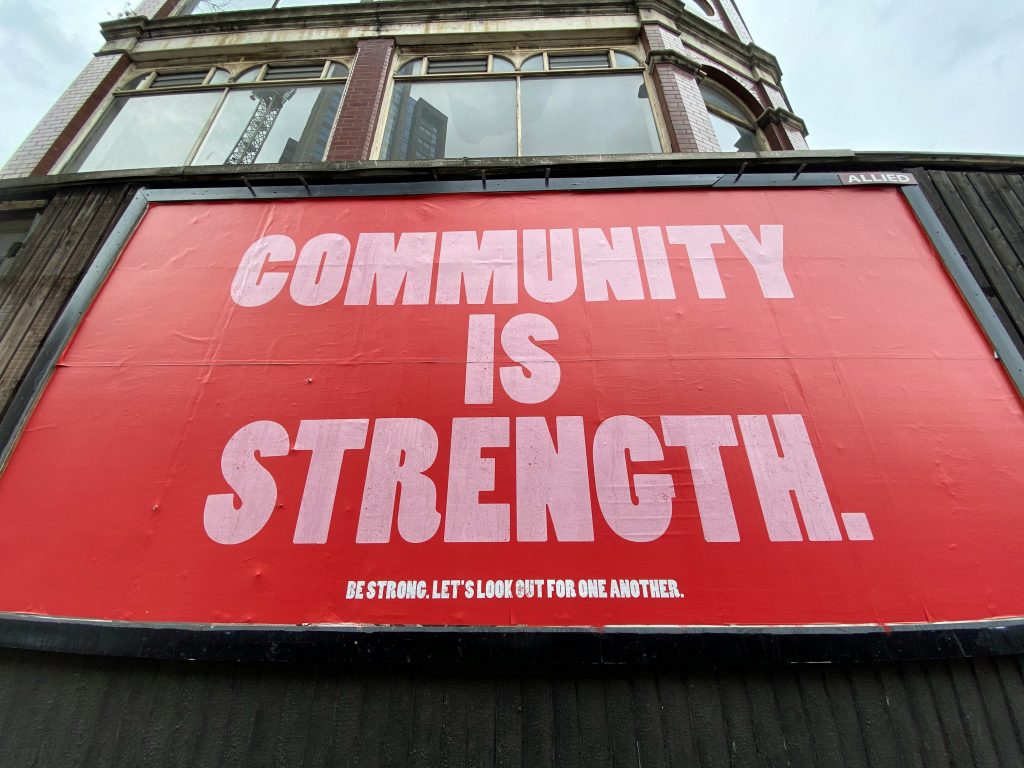
 I live in a small town where everyone knows everyone. Usually that’s really fun because seeing familiar faces while snowboarding with our son, on the trail with our dog, at restaurants and events, and in the carpool line at school is welcoming and enjoyable. We are also fortunate to live in a friendly neighborhood with lovely neighbors who genuinely care about each other. That’s the good news about living in a small town. The tough part about living in a small town is that there is a common misconception about the term “community.”
According to Merriam Webster, the word community is defined in three ways: 1) “a unified body of individuals” 2) “a state or feeling of caring about and wanting to interact with others in a group” 3) “society at large.” I think many view community as the neighborhood or town they live in and the friends/colleagues they choose to surround themselves with on a consistent basis – at least that’s how I view it. But nowhere in the official definition does it say that people’s responsibilities belong to someone other than themselves.
There is a fine line between a neighbor or friend asking for help when they are in a bind and expecting people to pick up the slack because they did not plan properly, don’t feel like handling the logistics, or want to avoid spending money by putting their predicament on someone else. This goes for taking care of children, dogs, professional obligations, house responsibilities, and the list goes on and on. My family is always happy to lend a hand to friends and neighbors within reason. And it doesn’t need to be an emergency to warrant help – our people mean a lot to us and there are all kinds of ways to fairly and reasonably help one another. But there is a line.
While assuming or expecting that someone else will take care of your dog, kid, responsibilities, errands, etc. is ridiculous in and of itself, the worst offenders are those who pretend to value “community” when in reality they are being opportunistic. One example is when a person declines to do a favor and the person who asked the favor gaslights them under the guise of community. Sometimes they will even throw in a played out comment like, “Come on. We’re all in this together.”
What happens next depends on the individual. Some stand their ground while others get bullied into conceding. Sometimes it’s because they feel guilty for saying no to the favor and that does not feel good. Other times it’s because they have repeatedly been put in this situation and don’t have the energy to argue. That is the worst because then opportunistic people realize they have an easy mark and will therefore continue to take advantage.
Setting boundaries and saying no can be really hard so preaching community when what the person really means is “I don’t want to logistically or financially take care of this myself” is completely unfair. They are blatantly overstepping by putting unrealistic expectations on others and that is not okay. If someone says no, that is the end of the conversation. They don’t need to explain themselves. Asked and answered. No. Is. A. Full. Sentence. End of story.


Leave a Reply