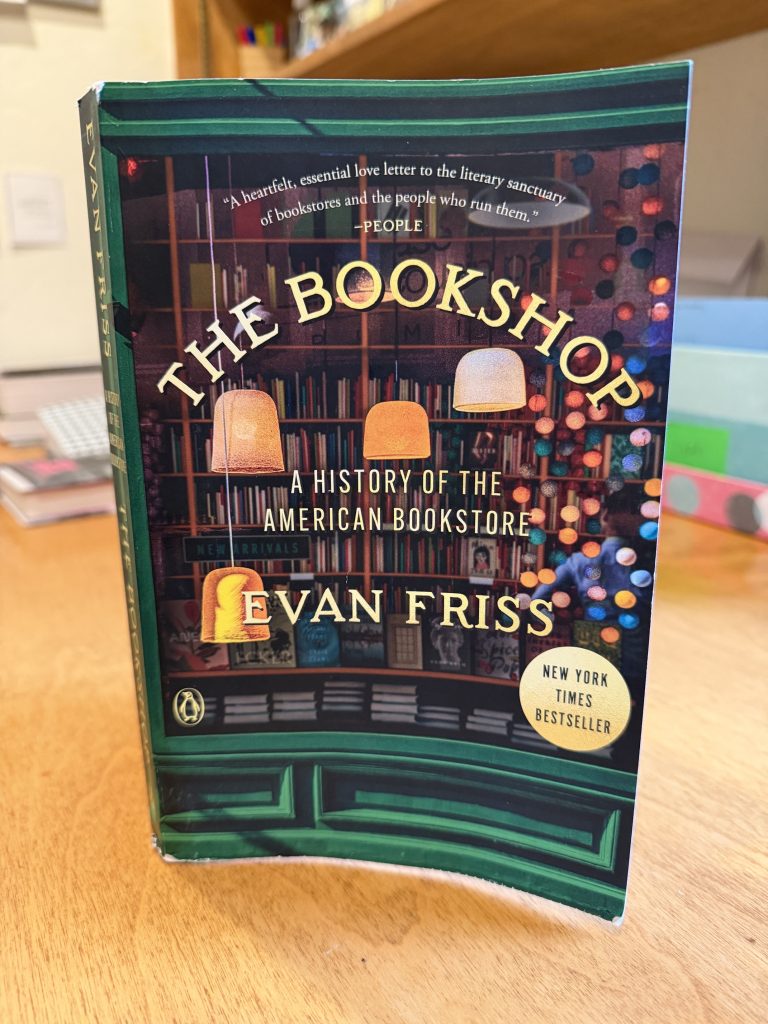
 Bookstores remind me a lot of record stores. Customers go to both places with an idea of what they want but they are also there to browse. They ask booksellers and record store clerks for recommendations and next thing they know everyone is talking about their favorite albums, books, shows, and stories behind the music and literature they love. In the heyday of record stores, whether customers were buying something for themselves or gifts for others, shopping for records, tapes, and CDs was a ritual. Getting to know the people who worked at their local spot was part of the experience. The same goes for bookstores.
In The Bookshop: A History of the American Bookstore, author Evan Friss delves deep into the history of booksellers, bookstalls, mobile bookstores, independent bookshops, and retail bookstores. I learned that some of the first bookstores were pop-ups and many people sold and bought books at bookstalls rather than brick and mortar locations. Also, there were several bookstores (or bookshops as many people in the business preferred to call them back then) that functioned as publishing houses as well. That wouldn’t work now but made sense at the time as “booksellers were on the front lines.” In fact, Benjamin Franklin was one of the first!
As independent bookstores went the way of superstores, so did record stores which was the beginning of the end for the record business. It breaks my heart that so few record stores still exist. It was my childhood – my education! In the chapter about Barnes & Noble, Friss says that people were afraid that the chain would kill independents and maybe even books in general. “For the latter part of the twentieth century and the beginning of the twenty-first, Barnes & Noble was a powerhouse. It shaped our very notion of what the American bookstore was and what it might become.” The second owner of the chain wanted the stores to function as “second homes” which is similar to what Christopher Green, owner of The Bookworm in Edwards, calls his store. I recently wrote an article about The Bookworm’s upcoming 30th anniversary and, when I interviewed Green, he said the store is a “third place” for people – the place that’s most important to them right after home and work/school.
I’m glad that Friss mentions the movie You’ve Got Mail because in 1998 art was imitating life – both in the book business and the record business. My family experienced it with Spec’s Music and Friss points out the same. “The mall-based bookstore era was fading. So were the music sections in many a bookstore as Americans abandoned CDs for digital music.” Another issue, which pains me to even type, is that Americans were reading less. “The TV was no longer to blame; it was the internet.” And that was 1998!
The author goes on to discuss how, as time went on, the battle between independent and chain bookstores was no longer the biggest issue – instead, it became a battle between in-person bookstores and Amazon. Of course, everyone living in 2026 knows this already but everything comes back around. So much that was retro is new again. This notion extends to writing as well. When I graduated from college 20 years ago with a degree in English, many people shared their unsolicited opinions about the impossibility of finding a job as a journalist because magazines and newspapers were dying. Guess what? I’m still writing for magazines and newspapers. Holding a publication in your hand is not the same thing reading on a screen. Also, there is no digital equivalent of the front page or front cover. End of story.
Thankfully, even though Amazon continues to thrive, people still buy books at stores, enjoy their vinyl collections, and even make an effort to spend less time in front of screens. I just bought a boombox for our son because, since he already knows how to play records, I want to teach him how to use CDs and tapes too – especially since I refuse to ever get rid of those collections.
Back to the book. The framework of The Bookshop is comprised of Friss talking about the nuances of the variety of bookstores he has visited and how the owners, patrons, and booksellers shaped the business. I learned that as long as there have been booksellers there have been traveling booksellers – whether that was via wagon or car. That camaraderie continues: “Bookstores can be romantic spaces, places full of discovery, of chance, of wonder. They can be community spaces, activist spaces, political spaces. And they can be refuges, places to lose and find oneself.”
As expected, this book is a love letter to bookshops, the people who run them, the people who frequent them, and the people who care about them. The author clearly did his research – there are 66 pages of notes at the end of the book – and it’s obvious he is one of those people. He cares. Similar to Penny Lane’s quote in Almost Famous in which she talks about going to the record store to visit your friends, the same can be said about going to the local bookstore.
Dates
- 1760 – first known use of the term “bookstore”
- 1905 – first bookstore on wheels
- 1919 – the first book fair took place in the form of a five-day book festival
- 1929 – there were approximately 30 bookstore chains but none were giants
- 1958 – Americans purchased roughly 72 percent of their books from small, independent bookstores
- 1993 – 13,499 bookstores in the United States
- 1995 – Amazon.com went live
- Between 1995 and 2000 – 43 percent of independent bookstores closed
- 2006 – Amazon’s sales crossed $10 billion
- 2019 – Amazon’s annual sales reached $280 billion
- By 2021, only 5,591 bookstores existed in the United States. Additionally, Bookshop.org boasted 1,100 participating stores and was doing $54 million in annual sales.
Fun Facts
- Common Sense was America’s first bestseller.
- New books come out on Tuesdays. Same with new music!
- Field’s was the first book superstore.
- A bibliophile is a person who loves or collects books.
- Both Books & Books in Miami and Tattered Cover in Denver are mentioned.
Quotes
“If bookstores were animals, they’d be on the list of endangered species.”
“The right book put in the right hands at the right time could change the course of a life or many lives. Readers, writers, and literature are shaped by how and where we buy our books.”
“Being surrounded by books matters. Sociologists have found that just growing up in a home full of books – mere proximity – confers a lifetime of intellectual benefits.”
Benjamin Franklin: “He understood that we are what we read.”
“Books hold ideas. Ideas hold power.”
“How bookstores were organized changed how people thought about books, the way they related to one another, and which books customers discovered.”
“Browsing in a bookstore was an experience, one that was changing the very function of the bookstore and one that was altering the trade.”
Gotham Book Mart owner: “She thought writers were the most wonderful people in the world and vowed to nurture them.”
Roxanne J. Coady: “The bookstore was intended to be a space ‘where words mattered, where people would gather, where writer could meet reader.’ It didn’t take long to confirm what she already believed: ‘Books can change lives.’”
“A bookstore needs to be a more than a place to buy books if it is to survive.”


Leave a Reply