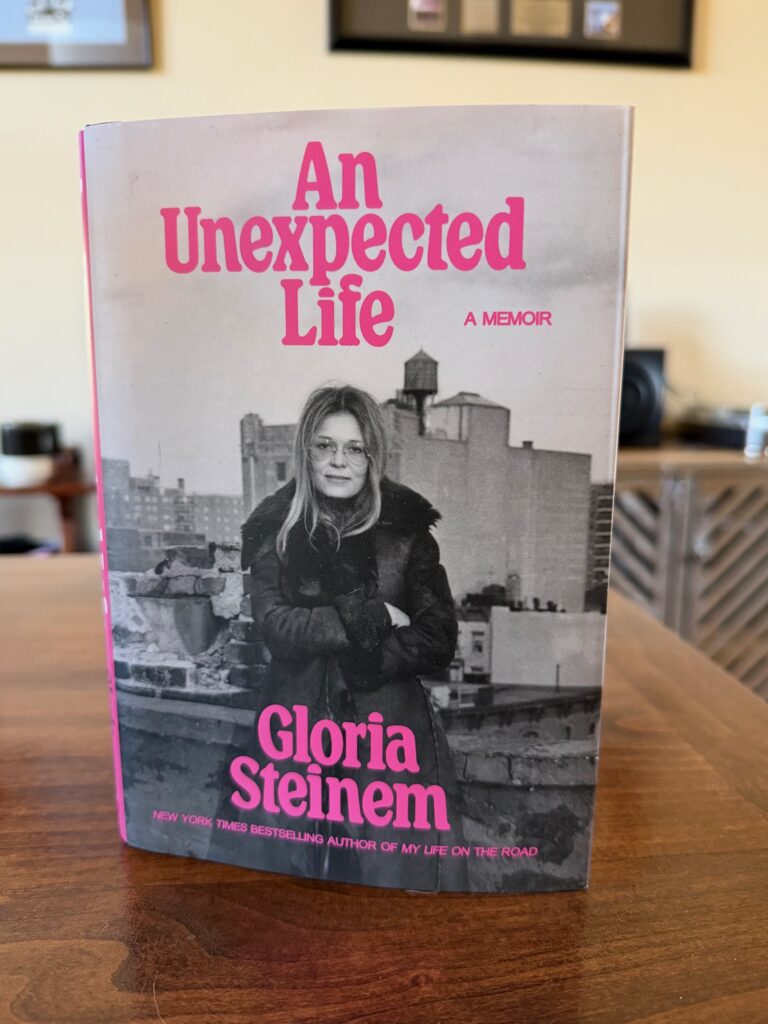
 Legendary journalist and activist Gloria Steinem’s final book was published 20 days after she died. In An Unexpected Life, which was released on September 22, 2026, the author somehow chronicles her entire life in 200 pages. Clearly she mastered the art of “less is more.” Steinem passed away on September 2 at the age of 92 (lots of 2s in the first few sentences of this review) which is eerie timing because, in what ended up being her last book, she went back and forth between thinking she had many years ahead of her and planning for what she wanted to have happen to her legacy and physical home once she was gone.
Although the terms “activist” and “feminist” have their various connotations, Steinem was one of the first to make female activism something to believe in throughout the 1960s and 1970s. While she refers to herself as an “organizer” rather than an activist, she spent her life putting herself out there for others and drawing attention to the absurdly unfair treatment experienced by so many for so long. “Supporting reproductive freedom as a basic human right is crucial to saving our planet.” Steinem made it her mission to fight for the disenfranchised, reproductive rights, and equality among all races and sexes. “I learned that experiences that introduce us to difference are the ones we learn from.”
Though I wouldn’t necessarily call my mother a feminist, she is similar to Steinem in that she has always made championing women a priority. In the 1980s and 1990s, my mom broke every glass ceiling in South Florida as one of the few female CEOs. Similar to Steinem, she is extremely humble about what she has accomplished and what she continues to accomplish, but the fact that they spent a lot of time helping other women is something to be recognized.
Clearly Steinem’s work for the greater good makes her exceptional, but I picked up An Unexpected Life because of her journalism background. She was one of the founders of New York magazine, started her own magazine called Ms., and wrote eight books. Incredibly impressive. “There is something about seeing the printed word, so portable and personal, that can change our idea of the possible.” AMEN. In the first chapter, she rhetorically asks how a person becomes a public figure and then answers: “It turns out that one can do so just by writing a book.” That made me laugh out loud because it’s so true.
Being a “girl reporter” was tough for Steinem and so different from the time I cut my teeth in the business 20 years ago. She had to deal with an unbelievable amount of sexism and unfair nonsense like not getting assigned the stories or interviews that dug deep. However, she was still able to make a name for herself and became an OG writer for magazines like Cosmopolitan (she wrote an article about The Beatles before they were a big deal), Vogue (she penned a profile on author/activist James Baldwin), and authored an undercover story about the Manhattan Playboy Club that garnered a ton of attention.
A big theme of this book is how everyone, regardless of race or sex, are part of the “human family.” Steinem is nothing if not inclusive. Several times she points out how Black women were “often seen for their race and not their gender” and the horrifying medical treatment they received in general and, more specifically, regarding reproductive rights. It was beyond disgusting. “These truths are a harsh reminder that, if we don’t learn from history, we are condemned not only to repeat it but also to be punished by it.”
As with most people, Steinem’s upbringing had a huge impact on her. Being forced to take care of her sick mother as a child informed the rest of her life as she never wanted to be responsible for another person again. As a result, she chose not to marry or have kids because she didn’t want the burden and refused to conform to societal norms. “Whether our upbringing is odd or ordinary, we can use it and build on it.” She also highlights the importance of breaking the cycle of crazy: “Only when we trace the origins of our still-painful bruises may we understand that current events are not the cause of what we are experiencing…We begin to make our decisions rather than continue patterns of the past. With this healing comes more possibilities.”
The final chapter of the book is all about the importance of sharing truths and emphasizing humanity. Throughout her career, Steinem spent a lot of time talking with and organizing groups of people who had discussions that arguably changed the course of history. “The most crucial force is bringing people together.” Whether she was at a speaking engagement or hosting a talking circle in the living room of her own house, she was someone who brought people together. “Listening is just as creative and necessary as talking.” Steinem did a lot of listening during her life and then made moves to back up her beliefs. We are all better because of her efforts.
Quotes
“I hope you will feel free to scribble comments in the margins as you go.” A journalist always reads with a writing utensil in hand.
“Whatever may be happening in life, books are reliable.” YES!
“Our shared humanity means we are linked, not ranked.”
“Better to start later and right than to start early and wrong.”
“Being remembered with love is the best form of immortality.” And she will be. ❤️
“Every example of justice helps to set us free.”
“We never know what might come from our chance encounters when we keep our minds and hearts open.”
“Nature is to be learned from, not conquered, and the symbol of society is a circle, not a pyramid.”
“The path to our future might be one story at a time.”
“If entrepreneurs are the creative artists of the business world, then organizers are the entrepreneurs of the social world.”
“No one, male or female, can have it all if we have to do it all.”
“Progress is not a straight line.”
“When people ask for advice, suggest that they listen to themselves.”
“Revolutions that last don’t happen from the top down; they grow from the bottom up like a tree.”
“Ideas change history.”
Quotes About Writing
“The written word has always been magic to me.” Me too.
“It’s difficult for writers to escape the temptation to be exemplary. The public wants them to be heroes.” ~Sam Bellow
“Writing is the only thing that, when I’m doing it, doesn’t make me think I should be doing anything else.”
“The joy of writing has always come from having an idea and trying to communicate it on paper.”


Leave a Reply