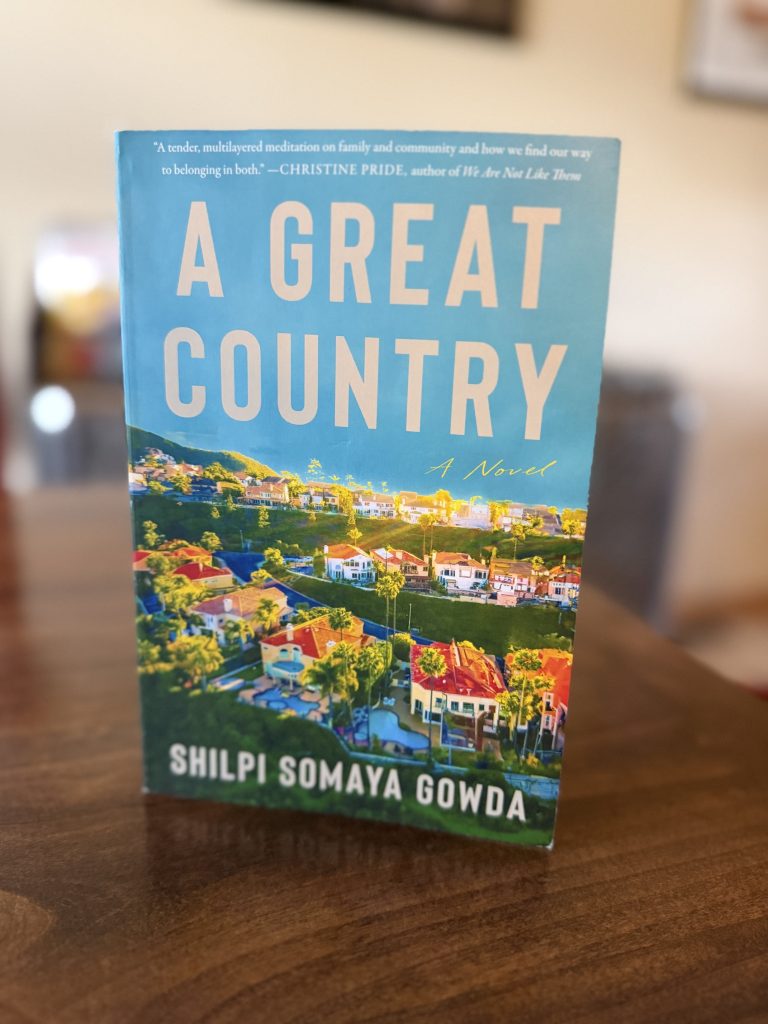
 After hearing Shilpi Somaya Gowda speak in July at The Literacy Project Luncheon, I picked up A Great Country because the author was everything I look for in a speaker – poised, engaging, well-spoken, and down-to-earth. She’s also an excellent writer. Although I handle the public relations for The Literacy Project, choosing the featured author for the annual luncheon is not my jurisdiction and I usually don’t know much about the speakers. That being said, writing press releases for and attending the event each year introduces me to books I may not have otherwise read.
Published in 2024, A Great Country is about an Indian family’s experience with the many facets of the American Dream. When the narrative begins, two parents (Priya and Ashok Shah) and their three kids (Deepa, Maya, and Ajay) have recently moved into a tony Southern California neighborhood. Over the course of one night, each kid experiences a variety of incidents. As promised by the author in her talk, the narrative moves at a rapid-fire pace (which I like) and provides third person histories and perspectives of each family member – as well as their adopted aunt and uncle (Archie and Ricky).
The story explores many themes including family ties, adult and adolescent friendships, the American legal system, relationships with neighbors, the importance of having a sense of belonging, the price of fitting in, and whether people really can get over judging a book by its cover. Thanks to Gowda’s writing style, the parent/child dichotomies and the relationships among the adult characters are realistic and relatable. Throughout the chapters, the reader learns how Priya and Ashok legally immigrated from India to America 20 years ago, met Archie and Ricky, and navigated finding jobs, starting companies, and welcoming children – all born in the United States. It has been quite a journey for everyone.
At its core, this book is about the American Dream being subjective, the importance of doing whatever it takes for your family, and understanding and prioritizing the friendships that really matter. I love that the book is dedicated to my favorite character – Archie – who is kind, straightforward, non-judgmental, and genuine. “Archie’s strength and optimism were pillars [Priya] had come to depend on.”
Priya and Archie’s relationship accurately depicts the most important kind of friendship – when friends are truly there for each other with an ease that can’t be explained or artificially created. Conversely, the author shows the reading how forcing relationships with people who aren’t on the same page and do not have the same values can lead to disappointment and discomfort. “Priya knew that support and friends came in different forms.”
Examples:
When Priya questions how well she knows her children, Archie replies: “You do know them. They are just complicated little creatures, like all of us.”
When Priya wonders whether sending Deepa to India was an overreaction, Archie says: “Maybe that exposure to her extended family, another country, her parents’ culture, maybe all of that helped shape the person she is today – her values, her loyalty, her strength. Trust me, that fire in Deepa is going to save us all.”
Most of the narrative takes place over the course of two weeks but a lot happens. Every step is fascinating and worth the time to read. For those wondering if the title comes with a sarcastic tone, it doesn’t. That being said, America’s law enforcement, politics, and legal system are all depicted and it’s all written in a way that is fair, descriptive, and thorough. In fact, Gowda definitely did her research as she drew from firsthand experiences during her internship with the Minneapolis Police Department that was part of her college scholarship. She saw a lot and took notes – all of which turned out to be the inspiration for A Great Country.
As previously stated, the narrative is like a freight train that never stops – in the best way possible. And while the overall theme (and title) is about America as a country of possibilities, at it’s core, the story is really about family, friendships, and choices made along the way.
Quotes:
“Each time Deepa didn’t fit neatly with her parents’ life plans, it seemed, they sent her away.” Not accurate but interesting to read a teenager’s perspective on what she doesn’t know were extremely difficult choices made by her parents.
“[Ajay] was excited about capturing the images he’d been so curious about and hadn’t found anywhere else. All those patterns of runways and taxiways, creating a geometric labyrinth from the sky.” A fascinating and crucial peek into the inner-workings of the youngest sibling’s mind.
Ashok’s take on getting Ajay tested: “There was a culture of overdiagnosis in this country, of treating everything with medications and therapy.”
“[Priya] knew his willingness to deal was one of the qualities that made [Ashok] successful in business, but sometimes she wished he would just take a stand, regardless of consequences.”
“There was a long silence while the parameters of their friendship reorganized themselves into a familiar and reliable shape.”
“She couldn’t tell where to direct her anger.”
“When it came down to it, the Shahs were being held up by their strongest friendships and held together by themselves.” That’s family – the people you care about and who care about you.
“I am a mother first, and my first duty is to protect my children.”
“In their quiet moments, he and Priya reassured themselves that this was not giving up – it was going home.”


Leave a Reply