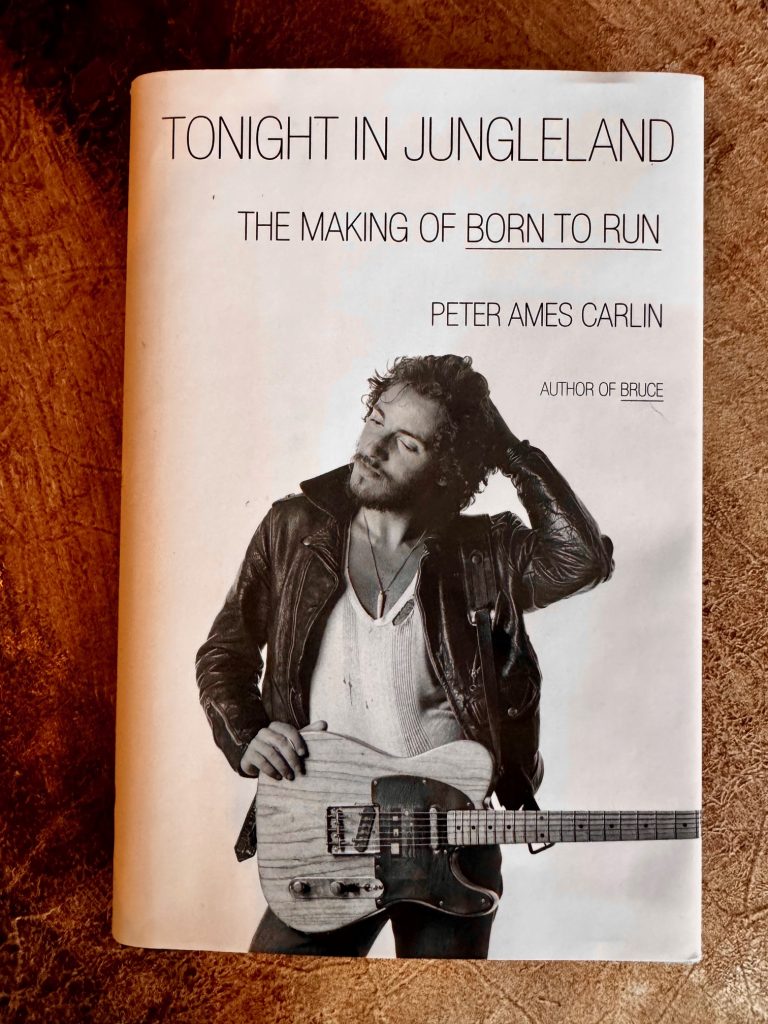
 How does one even begin to write about the music, life, and legacy of Bruce Springsteen? In 2013, author Peter Ames Carlin published a biography called Bruce that apparently, in 512 pages, covered Springsteen’s entire career. Then, in 2025, he told a smaller story about the making of Born to Run called Tonight in Jungleland. In 237 pages, Carlin goes through all the nuances of how the album got made – including the people involved, the agonizingly meticulous process Springsteen thought was necessary to make the record happen exactly the way he wanted it to happen, the undeniable influence of Mike Appel and Jon Landau, the “future of rock and roll” article that changed everything, Columbia Records’ initial lack of belief in the spirit of Springsteen, and what it all means now. Here are the highlights:
In the early days, Springsteen couldn’t shake the Bob Dylan comparison which is fascinating considering how different they are in terms of style. I get the songwriting comparison and the scruffy look Springsteen was known for then, but their careers clearly turned out very different. At this point, most of what they have in common is that they are both rock and roll legends.
Because I had already seen Deliver Me From Nowhere, I knew about Springsteen’s father’s mental health issues so it’s interesting that they are touched on frequently throughout the narrative but aren’t as big of a theme as in the movie. “Douglas Springsteen…fought his demons as hard as anyone could. It was never a fair fight.” Having a parent with mental illness is hard to understand as an adult, nevermind as a kid.
In 1975 Springsteen was all about the highway, car culture, getting out of town, and making something of himself – and that freewheeling (see what I did there?) mindset definitely resonated with a lot of people. And, according to the book, anyone who doubted Springsteen back then usually changed their mind after seeing him live. That was true of Landau who, at the time, was writing for a Boston newspaper called The Real Paper. After seeing the singer perform, he wrote a review that featured the line that changed the trajectory of both their careers: “I saw rock and roll future and its name is Bruce Springsteen.” Power of the press.
Appel and Landau fought tooth and nail to get Springsteen noticed with Born to Run – no question about that. According to Carlin, “when the two coproducers’ beliefs clashed, the air between them would turning sulfuric.” As a fellow writer I can tell you that no one uses chemical element metaphors if they aren’t serious! Later in the book the author adds, “Part of the challenge for Appel and Landau was in working with their artist’s eagerness to try every possible option and then hold off on deciding which one he preferred.” I can’t even imagine the frustration that came with that undertaking.
Both Appel and Landau went to bat for Springsteen repeatedly and talked him down from multiple creative ledges. “Only the music mattered. Every word, note, strum, and shout had to be right because this was it; there was no later, only right here, right now, and everyone in the room had to invest their labors with the same sense of mission.” Even Jimmy Iovine remembers the laborious process of working with the perfectionist Springsteen. “He didn’t want anything that you had, he didn’t want anything anybody had. He just wanted to be great.”
It’s also clear that they knew they had a talent so big it was beyond lightening in a bottle and wanted to be sure the world knew it too. It takes a village to make music sound flawless and look easy and Springsteen and his band knew what they were doing. I’ve always thought that Springsteen and his E Street Band sound like a jangly rock and roll celebration and that’s one of the reasons why Born to Run was so groundbreaking. The author points out that “one of the things that made Born to Run songs distinctive was how many of them began with instrumental preambles.”
Although I enjoyed this book, especially since I love hearing backstories about musicians and albums, the record I know best is Born in the USA because it has more of those big rock anthem that I gravitate to no matter what. In the second to the last chapter, I learned that on the same day in October 1975, Bruce Springsteen was on the cover of two of the most influential magazines at the time: Newsweek and Time. “Their power to define current events and dictate the national narrative was unrivaled. For a rock musician to be on either magazine’s cover was a big deal.” Again, power of the press. Since the beginning of my professional writing career, I’ve been hearing about how physical publications are going to disappear and that hasn’t happened yet. Of course, things have changed across the journalist landscape over the last 19 years but there is still nothing online that compares to being on the cover of an actual magazine.
Clearly this book is well-researched and well-written. Many of the 2024 interviews with Springsteen were conducted in-person and are described as a hangout session by a fireplace with a glass of tequila. That being said, Tonight in Jungleland is definitely meant for the hardcore fans. To appreciate this book is to really love and want to understand the details of the record that propelled Springsteen to the next level.
Quotes
“Bruce wanted to make certain his new songs had the economy and drive to fit modern radio, even as they traced some of the shadier corners of modern American culture.”
“The beauty they’re chasing has nothing to do with where they land and everything to do with having the courage to make the leap.”
‘“Born to Run’ went off like a stick of dynamite.”
Bruce: “We had streamlined ourselves into not a rock and soul band, but into a tight little five-piece streamlined rock n roll band.”
“For a kid who didn’t play sports or fit in with the popular crowd in school, joining a band was like joining a street gang for kids who didn’t like to fight.”
Bruce: “I want to make the last rock n roll album you’re ever going to need to hear.”
“In a time of reduced expectations and foreshortened horizons, with his own future severely in doubt, this skinny, bearded kid from blue-collar nowhere pointed into the distance.”
Bruce: “I wanted to write classic rock songs using classic rock song imagery, but I wanted to make it modern.”
“Clemons was a uniquely emotional player, one of the rare rock saxophone players whose tone could express as much sadness and introspection as swagger.”
“When people wrote or talked about his work, they were describing the essence of his soul.”
“The most vivid characters on the album all have the same goal: to leave the town full of losers; to hit the road; to get to the place where they really want to go, where they’ll hit it big, live in love, and walk in the sun.”
Fun Facts
“Thunder Road” was initially titled “Wings for Wheels.”
Steve Van Zandt got his start with Southside Johnny Lyon and his band the Asbury Jukes.

Leave a Reply