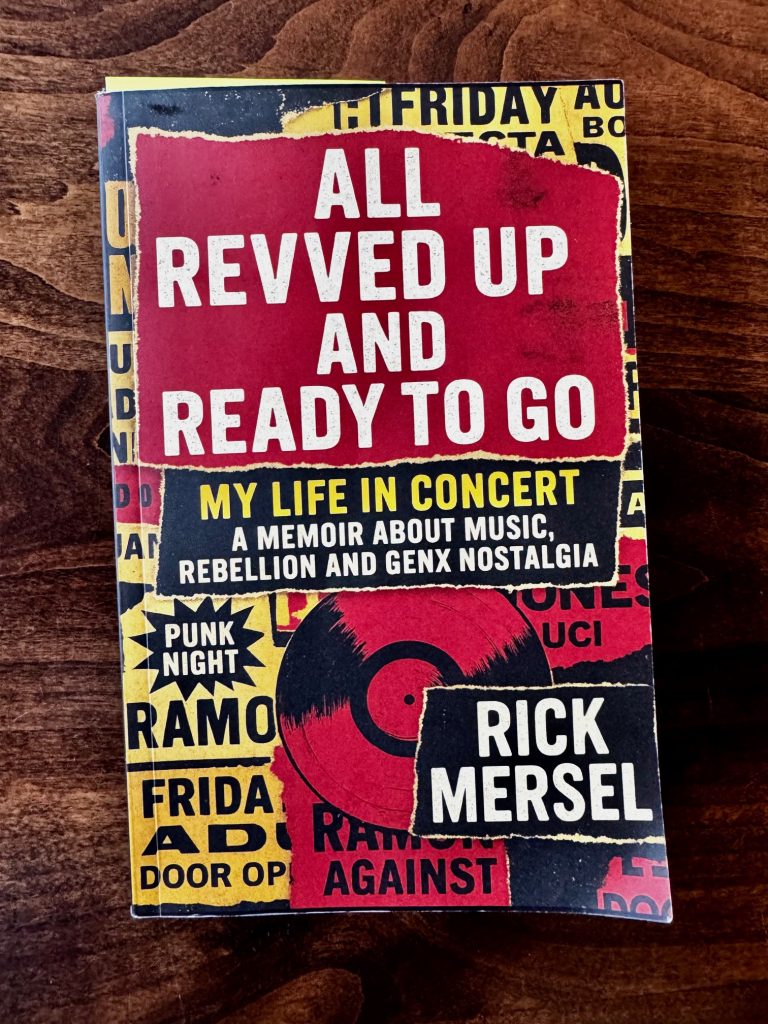
 Rick Mersel is my people. He feels music in his veins and it has shaped his entire life. Dedicated to his wife Laura, All Revved Up And Ready To Go is a love letter to everything live music has given to him. “This isn’t just a book about growing up with music. It’s how music grew me up.” Amen.
In the beginning, he describes finding a sense of belonging in a record store called Tracks Records – which of course I can relate to – and felt in real time that record stores are places of refuge. In fact, the entire thesis of this book is the importance of finding a place, scene, group, etc. that makes you feel like you’re part of something bigger. Something that matters.
Mersel talks a lot about how his rebellion led the way on his quest to finding his people which can be said for most of us who bravely lived through our teens and twenties. That being said, music was always his driving force and I feel that too. If music is the main character of the book, New Orleans is the number one supporting character as the author cut his teeth in the Bayou as a student at Tulane. “In New Orleans, time bent differently.” He also talks about local barflies “who could probably spin a five-minute story into an epic saga” which made me laugh out loud because we have all been there. “In a city like New Orleans, people were chaotic, transient, and unforgettable.” So true.
Music Is Magic
One of my favorite vignettes/stories is Mersel recalling his time working for a New Orleans radio station that featured live performances taking place at Tipitina’s – “a legendary concert venue nestled in the heart of Uptown” during which he offered “poorly informed reviews” of bands. One of the bands he skewered during his time there was Phish. Once again, I laughed out loud. Mersel is embarrassed by his review because Phish ended up having a huge fanbase, but I definitely would have written something similar about the band “going nowhere.”
Another memorable story outlines his pilgrimage to Woodstock 94 “with its promise of freedom, chaos, and a chance to lose [himself] one more time.” Although we know now that Woodstock 94 was a literal and figurative shit show with the mud, overflowing port-a-potties, and lack of food and water, the insider perspective of what went on inside “tent city” is a fun read. The bartering system he describes sounds like what Burning Man was like when I wrote about it 13 years ago. Also, the reminders of all the 90s grunge and alternative bands that made up the bill demonstrates how seminal that event should have been.
Years later, when Mersel opened The Bayou, he talks about all the huge names and up-and-coming artists that came through – including Aerosmith, Alice Cooper, Seven Mary Three, Vertical Horizon, and Def Leppard, among many others. “The Bayou provided just the place to help us all find the answers we were chasing.” Clearly he has an eye for talent as he went from “the kid pressed against the fence at a Ramones show…to the one choosing who got to be on stage.” What a thrill! “It was where we grew up, hooked up, broke up, got fucked up, and, somehow, learned to love each other.” But nothing lasts forever and the venue “slipped into memory the way things do when no one’s really ready to let go. It didn’t vanish. It dissolved into snapshots, old menus, old advertisements, someone’s half-remembered night.” Descriptions like that kept me turning pages.
Once he opened NorVa, big names showed up as well including James Brown, Stone Temple Pilots, Prince, Matchbox 20, Willie Nelson, and BB King. Before they were household names, the venue welcomed Kendrick Lamar, Billie Eilish, Post Malone, Fall Out Boy, The Strokes, and Frank Ocean, among others. “The NorVa wasn’t just a venue. it was a moment in time, a place where music history didn’t just pass through, it was made.” That’s the thing about moments in time – they are hard to identify when you’re in them. Mersel credits NorVa for “claiming a tiny piece of mythology before the artists were swallowed by stadiums and arenas.” When I read that sentence, I was instantly reminded of the small venues on Colfax in Denver and the Vilar in Eagle County.
The Words
While the editor in me definitely noticed the rough-around-the-edges aspects of the book – like the extra spaces, forgotten punctuation marks, and a few tangents – overall it is an excellent read. Mersel speaks from the heart and his love of music bleeds all over the pages. Additionally, All Revved Up is undoubtedly a love letter to New Orleans as he took that city with him in all of his creative and business endeavors. “If I couldn’t be in my hallowed land, I would build a shrine to it right here in Virginia Beach…One wall would feature a commissioned mural, an exact replica of my house on Magazine Street in the Garden District.” But he also had enough business intuition to understand and implement his friend’s wise words: “Promotional advertising shouldn’t be about begging for new customers. It should be about keeping the ones you already have…You don’t waste time chasing people who don’t care. You reward the ones who are already invested.” YES!
While I thought there would be more about NorVa, Mersel is direct about his contribution to live music and what’s next. I like that he appreciates and respects the past, but is not stuck there. “Now? It’s different. It’s not about proving I get it. it’s about passing it on. Creating the moment instead of chasing it. Building something that is bigger than me. A place where someone else can feel that same spark, that first jolt of belonging.” Music is definitely magic. And it’s never been more important to keep that love of music going.
Quotes
“I learned to shut up and listen, to let the music and the stories do the talking.”
“In a city like this, with that much music and madness, it was easy to feel like an extra in a movie about your own life.”
“Maybe this is what growing up looked like, not some grand epiphany, but small moments where you recognize the places you don’t belong.”
“The foundation of an era I had only dreamed about, until now.”
“NOLA had a grip on my soul.”
“Even if chaos was the brand, consistency mattered.”
“Music was the only constant.”
“The pulse. The chaos. The communion. It was never just a concert. Never just noise. It was something bigger. It was home.”
“Today, music isn’t just noise or rebellion. It’s my history.”
Fun Facts
Mersel’s uncle was Lee Leonard – who hosted NFL on CBS and NFL ’77 alongside Bryant Gumbel on NBC. Leonard was also the first face to appear on ESPN which meant he introduced SportsCenter to “an audience that had no idea what it would become.” He was married to Mersel’s aunt and then, years after she passed away, he married Kelly Bishop aka Emily Gilmore.
The author claims he came up with the premise for what would become The Read World – which he pitched as people of clashing backgrounds living together and starting a band. He interviewed for an internship at MTV but turned it down. A year later, The Real World we know debuted and, although the premise was working on various projects around the city rather than starting a band, it sounds very close to Mersel’s idea.
Side Note
In chapter three, the author credits a friend for the “Disco Sucks” movement but actually that comes from Fast Times At Ridgemont High. I know this for sure because I still have my “Disco Sucks” shirt in a box that I’m saving for Fleet. I’m surprised Mersel doesn’t mention Fast Times in this chapter because he references the movie later on in the book.

Leave a Reply